
Published October 27, 2026 · Updated October 28, 2026
Your customer wants a linen shirt that holds up on a hot commute. She asks ChatGPT, compares three options in the same chat and opens your product page already down to two brands, or never opens it at all.
That's the stake, because the comparison you used to win across Google results, marketplaces and your own pages now happens partly inside an AI assistant. If you're missing from the answer, you're missing from the shortlist. The channel is still small next to Google search, so your job is to get in cheaply without starving the channel that pays the bills. Platform details here are as of 28 October 2026, and they change from month to month.
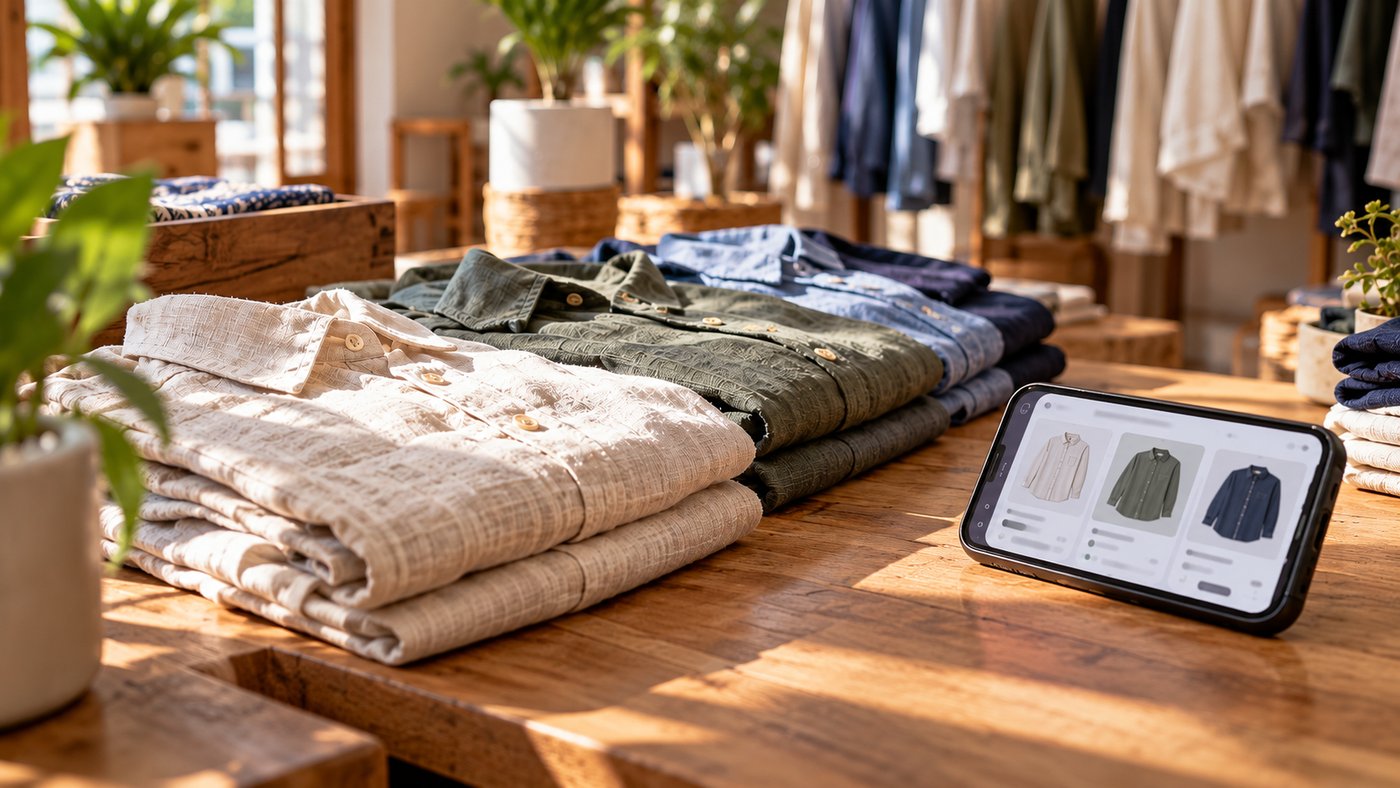
AI shopping assistants such as ChatGPT and Google AI Mode move the research stage of shopping into a conversation, so many customers reach a brand's site with a shortlist already formed. Your shopper describes a need in plain words, the assistant suggests products, and follow-up questions about fit, materials or price narrow the list without a new search.
Google's AI Mode runs on its Shopping Graph, which held more than 50 billion product listings in November 2025, and its answers carry price, review and inventory details for each product.
On ChatGPT, the sale still closes on your own site. Shopify's ChatGPT selling page says buyers finish on your store's checkout, opened in an in-app browser or a new tab. That makes your product page the place a recommendation is confirmed or lost, so check that your price, stock, reviews and return terms say what the shopper was just told.
ChatGPT, Google AI Mode, Microsoft Copilot and Perplexity differ in how they handle checkout and in how your products reach them. Ask your ecommerce lead which of these rows you're already live in.
| Assistant | What the shopper does there | Checkout | How a Shopify brand's products get in |
|---|---|---|---|
| ChatGPT | Asks for product comparisons and shopping research in chat | OpenAI scaled back Instant Checkout in March 2026, and purchases from Shopify stores finish on the merchant's own site | Catalog-eligible products are listed by default for US buyers through Shopify Agentic Storefronts |
| Google AI Mode and Gemini | Searches conversationally across the Shopping Graph, now with a Universal Cart | Agentic checkout with eligible merchants | Merchant Center product feed, with direct checkout for eligible Shopify stores selling to the US, Canada or Australia |
| Microsoft Copilot | Asks for shopping suggestions in chat | Direct checkout for Shopify merchants | Shopify Agentic Storefronts |
| Perplexity | Gets product cards inside an answer | Checkout with PayPal for US users, with the retailer as merchant of record | PayPal merchants through PayPal's store sync; Shopify's agentic storefronts page does not list Perplexity |
Perplexity's checkout launched with PayPal in November 2025, and OpenAI's pullback from Instant Checkout was reported by Modern Retail in March 2026. If you sell through PayPal and not Shopify, ask your payments lead whether your catalog is already synced.
AI referrals to US retail sites grew 62% year over year in July 2026 and converted at a rate 60% higher than non-AI traffic, according to Adobe data reported by Digital Commerce 360, likely because those shoppers did their comparing in the chat. Read how AI visitors convert before you set a target for this channel.
AI search is both a threat and an opportunity for a Shopify brand, and in October 2026 the threat sits mostly in early research traffic while the opportunity sits in fewer, better-qualified visits.
Marketers already report losing early-stage search traffic. In a Modern Retail+ survey of 142 brand and agency professionals published in January 2026, 37% said their companies had seen decreases in upper-funnel search traffic as a result of AI.
That's what marketers report, not measured traffic, and the sample mixes brands with agencies. Still, if your buying guides and blog posts are how you start a customer relationship and fill your retargeting audiences, take it as a warning.
When an assistant answers "best linen shirt for hot weather" with a shortlist, your shopper may never click the guide that used to introduce your brand. Brands left out of the answer lose that first contact, and the brands named in it get it without paying for a click.
Your guides still earn their place when they carry what an assistant can use, like plain comparisons, sizing, materials and links to the products they recommend. Pull your best-read guides this week and check each one against that list.
AI is still a small channel. In Conductor's benchmark for May to September 2025, AI referrals were 0.48% of website traffic in consumer discretionary categories, against nearly 18% from organic Google.
For a Shopify brand, getting in costs little. ChatGPT and Copilot listing is switched on through Shopify's Agentic Storefronts, so the work is product data and reputation rather than media spend. Spend your first hours on the catalog, not on a new ad budget.
Complete, accurate product data is the starting point Google and OpenAI both name for brands, although neither publishes how it ranks products. Listing facts such as price, availability and reviews, plus coverage on other sites, shape which eligible products get picked, and how assistants pick products sets out what's known about each signal.
Treat a guaranteed AI ranking as a red flag, and ask anyone selling one how they know, since neither company publishes its formula.

Start in your Shopify admin under Sales channels, then Agentic, to see which AI channels list your products, then fix titles, attributes, variants, price and stock so your feed matches your store. The rest of the order, from policies to markup to measurement, is in a readiness checklist for AI shopping agents.
Google organic still dwarfs AI referrals in Conductor's numbers, and most product data work helps both, so keep your Google search budget while this runs.
We are a performance marketing and AI search agency, and for Shopify brands we treat product data as the shared input to Google, ChatGPT and the product page.

Best Use of AI in a Client Campaign
Winner, 2025 US Agency Awards
Get a clear picture of where your store is losing revenue, what to stop now and which actions to take first with our DTC Growth Audit.
DTC Growth AuditNot for the organic picks, which OpenAI's documentation calls selected independently and not ads, as PPC Land reported, while ads in ChatGPT are a separate, labeled product bought as media.
Run a fixed set of shopper questions in each assistant every month, and read the agentic home in Shopify, which reports sales, orders and sessions for each AI channel.
For US buyers, yes, once products are eligible for the Shopify Catalog. An excluded product cannot be recommended, so check eligibility in the Agentic Storefronts settings.
Not for most brands in 2026. Organic Google still sends far more traffic than AI assistants, and Google's AI Mode draws on the same product data and pages that SEO work improves. Treat AI search as part of the same program, measured on its own.

Mike Le
Co-Founder, CB/I Digital and Conative AI
Mike Le co-founded CB/I Digital in New York in 2007 and has helped brands grow through search, paid media and data ever since. He started the agency's AI team in 2019 and later started Conative AI. He writes about how customers find and choose brands now that AI answers sit between them and the search results.
Follow Mike on LinkedInCopyright © 2026 CB/I DIGITAL INC. All rights reserved | Privacy Policy